


COB vs SMD LED Strips for Cabinet Lighting
Understand how COB and SMD strips differ in a cabinet detail. Compare the complete fitting for light points, useful output, reflections, cutting and control compatibility.
VOXAURA
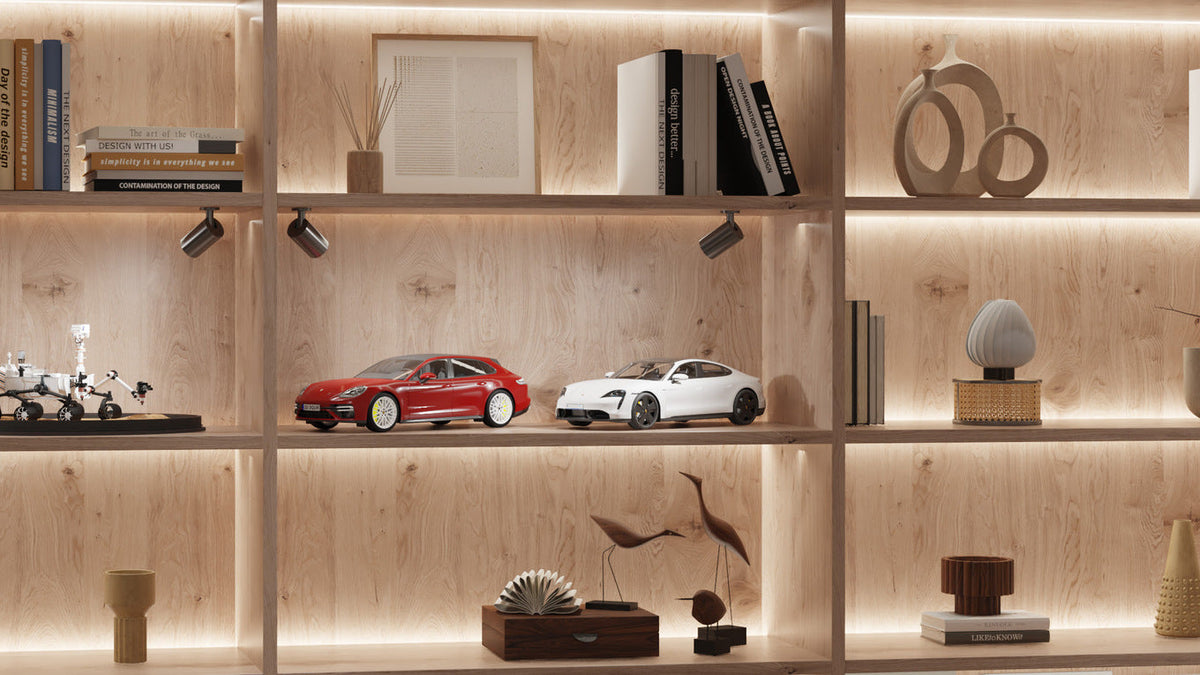
COB LED strips are often a useful starting point when you want a smooth line of light in a shallow cabinet detail. SMD strips can also work well, particularly when the fitting provides enough space to blend the individual light sources. Choose by the installed appearance, required light output and complete assembly.
For kitchen cabinets, wardrobes and display shelves, the practical question is how the strip will look and perform in its intended position. This guide explains what to compare before ordering.
What is the difference between COB and SMD?
SMD stands for surface-mounted device. An SMD strip uses separately packaged LEDs mounted along a circuit board. Depending on their spacing and the viewing conditions, you may see individual points of light.
COB means chip on board. In common white-light COB strips, closely packed LED chips and a continuous phosphor layer help produce a more continuous appearance. LEDVANCE's technical overview describes how this construction creates a uniform line in its COB products.
Those names describe construction. You still need the selected product's specifications to understand brightness, white colour, cutting requirements and control compatibility.
| Choice | A useful reason to consider it | What to check |
|---|---|---|
| COB strip | A smooth line in a detail viewed at close range | The complete fitting, reflections and required light output |
| SMD strip | A product whose output and fitting suit the project | LED spacing, diffuser and distance available for mixing |
| Either construction | A concealed light source illuminating a surface | Coverage, glare, colour quality and installation requirements |


Will COB remove every visible light dot?
COB can help reduce the appearance of individual points, but the complete detail determines the result. Look at the strip inside the proposed profile, with its intended diffuser.
With an SMD strip, increasing the distance between the LEDs and diffuser can help blend the points. A suitable diffuser and closer LED spacing can also help. A very shallow fitting leaves less room for that mixing.
Reflections deserve a separate check. A light concealed beneath a shelf can still appear as bright points or a line on polished stone, glass or a glossy cabinet surface. A continuous reflection may also be distracting if it falls in your normal view.
Test a representative section from the positions where people will use the room. Check both the fitting and the surface it illuminates. A photograph of a bare strip on a supplier's desk cannot show how your splashback or display cabinet will look.
Is COB brighter or more efficient than SMD?
Compare the numbers for the products you are actually considering. The construction name alone does not provide the answer.
The VoxAura Australian catalogue provides a useful example at the same electrical load and colour temperature:
| Catalogue strip | Construction | Selected 3000K article number | Power | Published light output |
|---|---|---|---|---|
| LS4000 | SMD | 200.10.00.002 | 5W/m | 950lm/m |
| LS4030 | COB | 200.10.00.026 | 5W/m | 475lm/m |
These figures describe the specified strips in that catalogue. They show why equal watts per metre can produce different light output. They establish a comparison between these two products, rather than a performance ranking for every SMD and COB design.
A project also includes the profile, diffuser, mounting position and power supply. For a kitchen benchtop, ask how much useful light reaches the preparation area. For display shelves, consider whether the light gives the intended coverage without overpowering the contents.
Energy use depends on the installed load, operating time and controls. If comparing energy performance, start with products that can meet the same lighting brief.
Where does each approach fit in cabinetry?
A narrow display shelf with a shallow visible lighting detail is a good place to compare a COB sample first. The continuous appearance may be valuable even where very high output is unnecessary.
For concealed lighting above a cabinet or behind a plinth, assess the illuminated surface. A suitably selected SMD assembly may give the required effect when its individual sources are hidden and the light has room to blend.
A kitchen task-lighting detail needs adequate coverage on the benchtop. Choose the output, position and shielding together. Changing from SMD to COB alone will not correct a fitting hidden behind an obstructing cabinet edge.
Check colour and control separately
Both construction types can be available with different white-light functions. Select the exact colour temperature or adjustable-white version required.
For example, the Australian catalogue lists LS4030 as fixed white. LS4031 includes fixed-white versions and a separate Multiwhite version. The Multiwhite article 200.11.00.002 provides a published 2700–5000K range and requires its matching power and control arrangement.
Also compare colour rendering for the selected variant. A smooth-looking line does not establish its CRI. If the cabinet displays timber, clothing or food, check the colour-rendering data and a sample on those materials.
Dimming is another system decision. Match the strip, driver, controller and control method. Choosing a COB strip does not by itself provide app control or adjustable white.
Cutting, profiles and connections still matter
Both SMD and COB strips have product-specific cutting rules. In the Australian catalogue, LS4000 has a 62.5mm cutting interval, while LS4030 and LS4031 have 12.5mm intervals. Check the physical markings and current installation instructions before cutting.
The connector needs the correct contact area, width and electrical compatibility. Allow space for connectors, end parts and cable exits when calculating the finished fitting length.
A conventional strip-and-profile assembly also differs from an integrated linear product such as VoxAura FreeCut. COB describes the light-source construction; FreeCut describes a product format that combines the light source, profile and cover. Compare those installation choices separately.
What should you ask the supplier to demonstrate?
Use a short, repeatable comparison:
- Fit each candidate into its proposed profile and diffuser.
- Use the intended white colour temperature.
- Compare on the same cabinet material and reflective surface.
- Check from the normal standing and seated positions.
- Compare usable illumination at the intended brightness.
- Test any dimming or adjustable-white functions you require.
Record the strip's article number and all the fitting components. This makes it easier to order the combination you assessed.
Frequently asked questions
Does COB need a diffuser?
Check the chosen product and fitting. A diffuser can contribute to the finished appearance and protection even where the strip already looks continuous.
Is a higher LED count always better?
Counts can describe different package structures. Compare the actual visual effect and product data rather than ranking unlike strips by that number alone.
Can I replace an SMD strip with COB in an existing profile?
Check width, connector space, thermal requirements, voltage, control compatibility and output. Physical fit is one part of the decision.
Which type lasts longer?
Use the selected product's lifetime information and installation conditions. The COB or SMD label alone cannot establish the answer.
Compare the complete cabinet-lighting detail
Bring Knox System your cabinet drawings, illuminated lengths and finish samples. We can help you compare suitable VoxAura strips, profiles, drivers and controls for the result you want.