

LED Strip vs Integrated Linear Cabinet Lighting
Compare separate strips and profiles with integrated linear lights such as FreeCut. Consider finished length, light quality, accessories and the complete installation cost.
VOXAURA
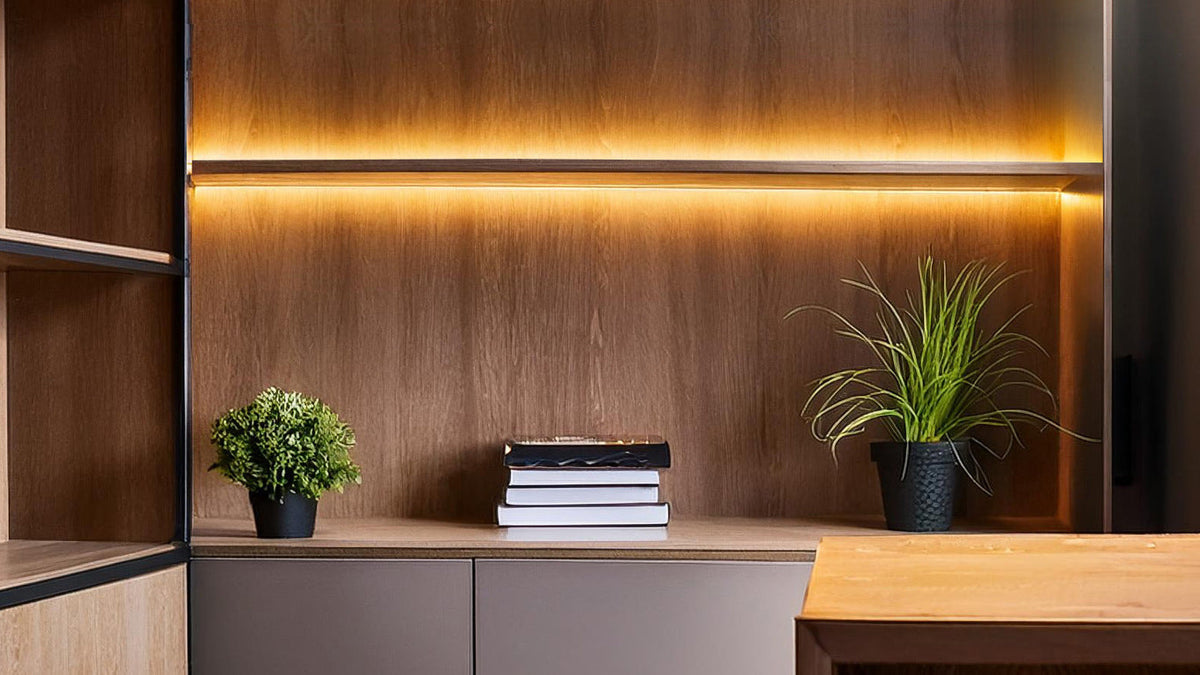
For cabinet lighting, both a separate LED strip and profile and an integrated linear light can produce a neat, continuous line of light. The choice depends on the cabinet detail, the required length, the light output and how much assembly you want to complete on site.
VoxAura FreeCut combines the light source, profile and cover in an integrated product. A traditional strip-and-profile system lets you select those components separately. Compare the finished assembly, required accessories and installation work when choosing between them.
What is the difference between an LED strip and a linear light?
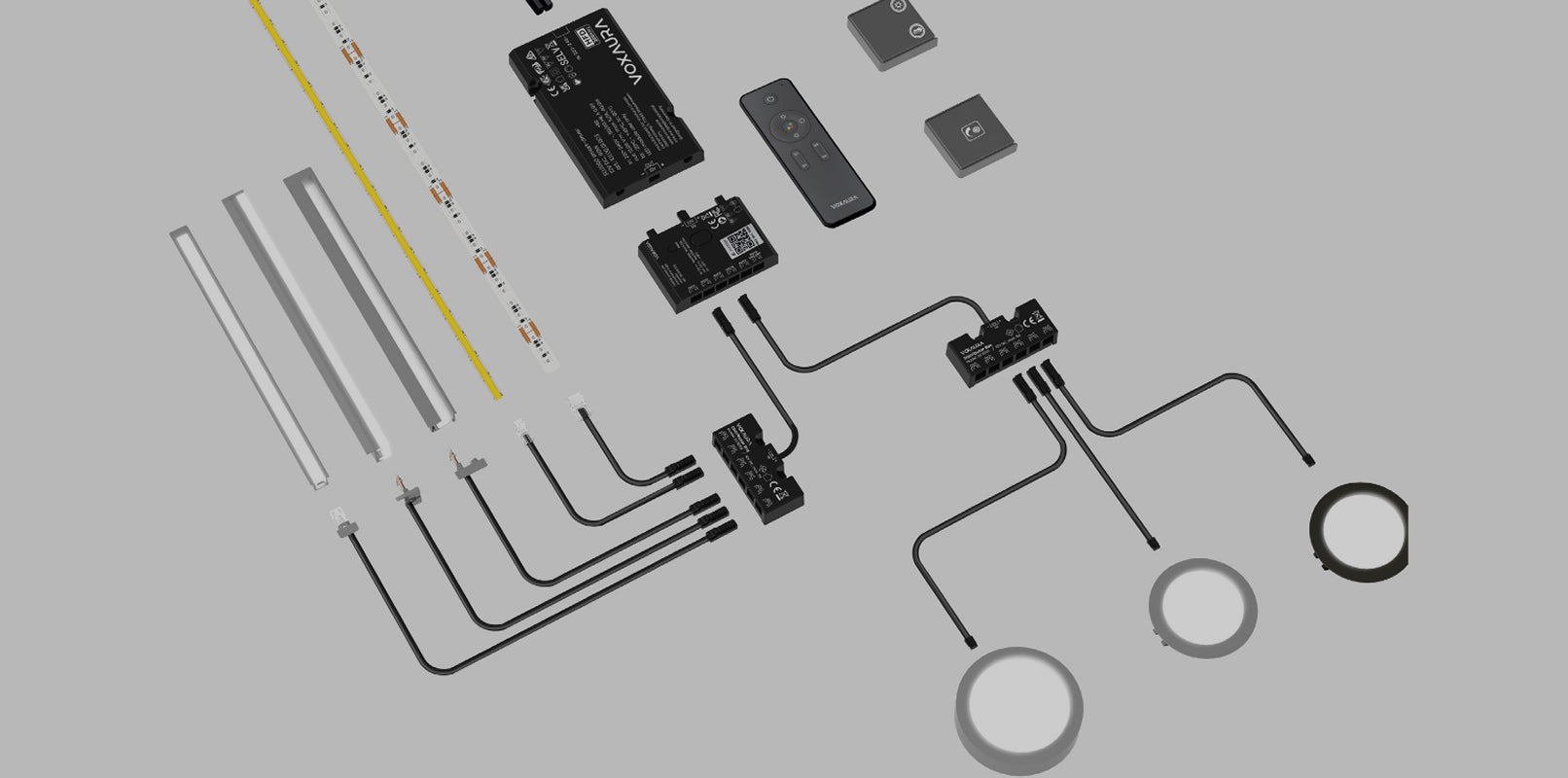
An LED strip is the light source: a narrow circuit carrying LEDs. In a typical cabinet installation, it works with a suitable aluminium profile, diffuser, power connection, end parts and fixings. The installer assembles those components into the finished light.
An integrated linear light brings the specified light source, profile and cover together before installation. You still select the correct model, length, connection parts and mounting method.
The terms describe the product format. COB and SMD describe LED construction, while monochrome and tunable white describe lighting capabilities. A product's complete specification tells you how these characteristics fit together.
| Selection point | Separate strip and profile | Integrated linear light |
|---|---|---|
| Components | Select the strip, profile and cover as compatible parts | The specified light source, profile and cover come together |
| On-site assembly | Allow for separate component preparation and fitting | Some of that assembly is already complete |
| Finished length | Check the strip's permitted cuts and profile/end allowances | Check the model's cutting and end-part requirements |
| Mounting | Choose a compatible surface or recessed profile | Choose the integrated model for the cabinet position |
| Light quality | Compare the complete strip, profile and diffuser | Compare the finished light's output and optical data |
| Quotation | Include all components, connections and labour | Include the light, required accessories and labour |
When does a separate strip-and-profile system make sense?
Separate components can suit a project with a particular output, white-light range, colour effect or mounting detail. You can choose a strip for the lighting requirement and a profile that fits the cabinet design.
The components must work together physically and electrically. Check the strip's PCB width, connector space, profile's usable internal dimensions, cover and mounting arrangement. The outside width of an extrusion does not establish its internal space or the size of the required cabinet recess.
For example, the Australian catalogue's AP1002 and AP1004 profile options list a maximum strip width of 8 mm. A wider strip needs a suitable alternative, even if the voltage and connector pin count appear to match.
Ask for a complete assembly sample. Its diffuser and mounting position affect the visible light line, reflections and the amount of useful light reaching the surface.
Where can an integrated light such as FreeCut help?
FreeCut can be useful where the cabinet needs a custom-length light and a consistent finished form. Bringing the light source, profile and cover together reduces the separate components fitted during installation.
That can simplify a run of repeated shelf or cabinet details. The installer can focus on the approved mounting detail, permitted length processing, connections and finishing.
A recessed model still needs the correct cabinet opening. Connection and end parts can also require space beyond the intended illuminated section. Plan these details while the cabinetry drawings are being prepared.
The VoxAura linear-light range includes different formats for furniture applications. Match the product to its actual position, such as a panel recess, side lighting or a glass shelf.


Why do cutting rules matter for custom cabinetry?
Cabinet dimensions and LED cutting positions do not always line up. Some strips allow cutting at marked intervals, while other products offer more flexible cutting. Check the actual product rather than assuming every strip follows the same rule.
As a planning example, suppose the required LED length is 1,020 mm and the chosen strip permits cuts every 50 mm. A 1,000 mm piece leaves part of the proposed run uncovered, while 1,050 mm is too long. Another strip with a different cutting arrangement may solve that detail.
An appropriate cut-to-size integrated light can also help. Check its minimum usable length, permitted cut direction, end connections and mounting requirements. Distinguish the cabinet opening, overall fitting length and illuminated length on the drawing.
For VoxAura FreeCut, use the instructions for the selected model. Processing and leftover-material rules vary across the range, particularly for sensor-operated products.
Compare light output at the finished fitting
The light source's specification and the finished assembly's performance can be different. A diffuser, lens and installation position affect how the light leaves the fitting and reaches the cabinet contents or benchtop.
Ask for the output of the configuration you are comparing. If one quotation gives bare-strip lumens per metre and another gives finished-fitting output, request comparable information before deciding which offers more useful light.
Also compare:
- Colour temperature or the supported tunable-white range.
- Colour rendering for the selected white-light variant.
- Light distribution and the direction of the beam.
- Visibility of LED points through the chosen cover.
- Reflections from stone, glass, mirrors or glossy cabinet finishes.
Use the same material sample and similar viewing conditions. A bright photograph alone cannot establish the output or colour-rendering performance of a fitting.
Which VoxAura format suits each cabinet position?
The Australian catalogue provides several different furniture-lighting formats:
| Cabinet detail | Example family | Main planning question |
|---|---|---|
| A light recessed into a panel | PL4000 | Does the model and its mounting drawing suit the board and lighting direction? |
| Light behind a panel or shelf | PL4002 | Is there room for the fitting, cable exit and intended light distribution? |
| Side illumination | PL4011 | Will the source remain comfortable to view while lighting the contents? |
| Glass-shelf lighting | PL4004 | Does the current model match the glass and clamping detail? |
| Sensor-operated drawer lighting | PL4005 | Are the sensor, power arrangement and permitted cutting method suitable? |
| Illuminated hanging rail | PL4006 | Are the support, sensor and connection parts included in the plan? |
These are application examples from the catalogue. Use the current product drawing and exact variant for a quotation, especially where the Australian and global ranges differ.
Do the two approaches need different controls?
Both formats need compatible power and control components. Choose the functions first: fixed white or adjustable white, dimming, a sensor, manual control or supported smart-home integration.
For VoxAura, fixed-white and Multiwhite variants follow different compatibility paths. Matching the connector's pin count alone does not establish compatibility.
Sensor products also need individual attention. The Australian catalogue lists PL4005 and PL4006 as non-dimmable. They use their own sensor arrangements and require the appropriate supply and installation parts. Plan them separately from a general dimmable group.
When comparing quotations, ask each supplier to explain what happens when a switch, sensor or scene operates. That makes the intended behaviour part of the specification.
Compare the complete installed cost
Build each quotation around the same cabinet detail, length, light effect and control requirement.
For a separate system, include the strip, profile, cover, connections, end parts, fixings and preparation/assembly labour. For FreeCut, include the selected light, required end and connection kits, fixings and the work that remains.
Check what each package includes. A product photo showing several accessories does not establish that they are all supplied with the light.
An integrated product may reduce assembly steps. The actual saving depends on the project and working method. Ask for measured installation information if a numerical labour or cost saving is part of the proposal.
Questions to settle before ordering
- What is the required illuminated length, and what space do the ends need?
- Is the fitting recessed, surface-mounted, side-mounted or attached to glass?
- Does the complete assembly provide the required light output and appearance?
- Which driver, controller and switch or sensor match the selected variant?
- Which accessories are included, and which must be ordered separately?
- How will the light and connections remain accessible for servicing?
Frequently asked questions
Does FreeCut need a separate aluminium profile?
The specified FreeCut product already includes its profile, light source and cover. Check the connection, end and mounting parts required for the selected model.
Can every off-cut become another working light?
Reuse depends on the model, intact connection structure, permitted length and available end parts. Confirm the rule for the exact product before allowing for reusable material in a quotation.
Is COB the same as FreeCut?
COB describes LED construction. FreeCut describes an integrated linear-light format. Check both attributes in the product data.
Which option is better for an existing cabinet?
Start with available space, mounting and cable access. A suitable surface-mounted profile may help where a recess is impractical. An integrated light can also be considered when its approved mounting detail fits.
Compare a complete cabinet-lighting solution
Bring your cabinet drawings, required lengths and control preferences to Knox System. We can discuss a VoxAura configuration and help identify the lights, matching power/control components and accessories needed for the detail.